
What Does 30±3 dB Actually Mean? Office Pod Sound Ratings in Real Life
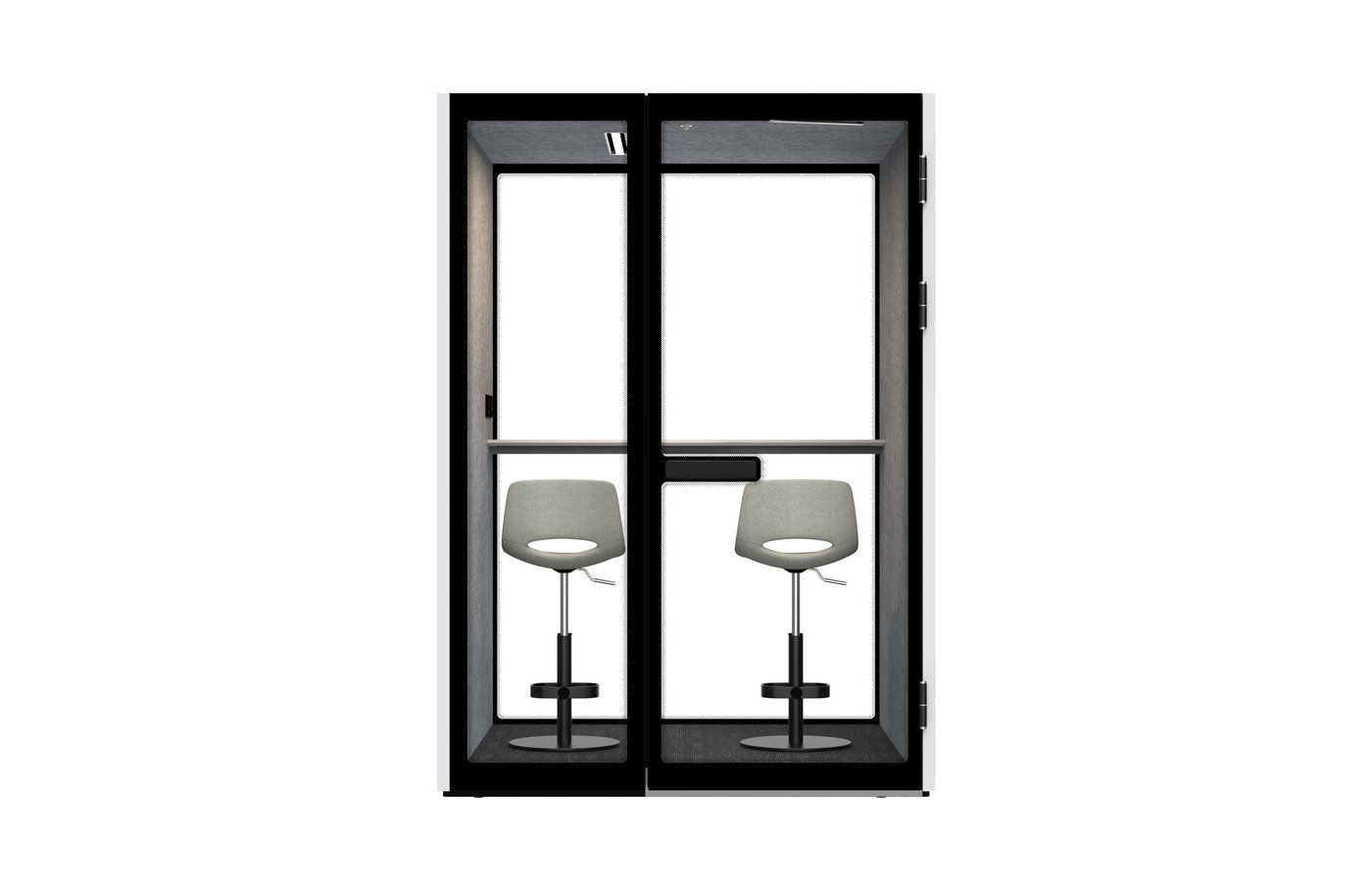
Open a quotation for office pods and you will meet the same line every time: a number, a ± sign, and the letters dB. One supplier writes 25 dB, another 30 dB, a third claims "soundproof" with no number at all. For the buyer who has to justify the purchase to facilities, finance and HR, these figures are strangely abstract — until the day the pods arrive and someone takes a call inside one while a colleague sits two metres away. That is the moment the rating becomes real. This guide explains what 30±3 dB actually means in a working office, how the test behind it is run, and where the honest limits of the number lie.
What does 30±3 dB sound like in a real office?
The decibel scale is logarithmic, not linear. A reduction of 10 dB is perceived by the human ear as roughly half as loud; a reduction of 20 dB sounds about a quarter as loud. A pod rated 30 dB of speech level reduction under ISO 23351-1 therefore shrinks a normal conversation inside — around 60 dB at one metre — to something near 30 dB outside: the level of a whisper or a quiet library. In practical terms, a colleague at the next workstation hears that someone is talking, but cannot follow the words. Confidential HR conversations, salary discussions and client calls stay private.
The steps between ratings matter more than the small digits suggest. The jump from 25 dB to 30 dB is not a five percent improvement; it is a clearly audible halving of what leaks out. A 25 dB pod muffles speech; a 30 dB pod turns it into an unintelligible murmur. At 32 dB, as in the Comine Booth Steel 2024 series with its 4+4 mm laminated glass and refrigerator-grade magnetic door seals, even raised voices dissolve into the background hum of the office.
How does the ISO 23351-1 test actually work?
Before ISO 23351-1 appeared in 2020, suppliers borrowed the Rw wall rating from construction — a figure measured on a single panel in a laboratory wall opening. It said nothing about the assembled product, with its door, seals, glass and running fans. ISO 23351-1 changed the question from "how good is the wall?" to "how much quieter does a voice become for the person outside?".
In the test, a loudspeaker inside the fully assembled pod plays a standardised speech signal — the spectrum of a human voice, not a synthetic tone. Microphones at defined positions around the exterior measure what escapes, and the result is reported as speech level reduction, D_S,A, in decibels. Because the pod is tested complete, the weak points are included: the door seal, the ventilation paths, the cable penetrations. A number earned this way describes the product you actually receive, not the raw material it is built from. When a supplier quotes a rating measured on the assembled unit with fans running, as BG Acoustics does across its booth-s, booth-m1-a and booth-l1-a models, the figure survives contact with your floor.
What does the ±3 dB tolerance tell you?
The ±3 dB is not an apology; it is a mark of honest measurement. No two production units are absolutely identical, and no two test rooms are perfectly repeatable, so a serious manufacturer states a tolerance band rather than a single heroic digit. A supplier who claims exactly 35 dB with no tolerance and no test report is usually quoting a material estimate, not a measurement. When you compare quotations, treat the tolerance as a credibility signal: 30±3 dB with a named standard and a report beats a bare 35 dB every time.
What will a 30 dB pod fix — and what will it not?
A 30±3 dB pod solves the dominant problem of the open plan office: speech. Phone calls, video conferences, interviews and one-to-ones stop leaking into the floor, and the chatter of the floor stops leaking in. Ventilation keeps the pod usable for long sessions — the booth-m1-a moves 140 m³ of air per hour through four silent fans, the four-person booth-l1-a 280 m³/h — so the acoustic seal never becomes a stuffiness problem.
What a pod does not do is turn your office into a recording studio. Structure-borne vibration, the rumble of nearby construction and very low-frequency traffic noise are building problems, not furniture problems, and no honest 30 dB rating promises to erase them. It is also worth asking about the noise the pod itself makes: fans and power supplies should stay near-silent, or the cure becomes a new distraction. These are the questions a good supplier welcomes.
Which ratings do BG Acoustics pods carry?
Across the Comine Booth 2026 series, the booth-s phone pod is rated 28±3 dB, while the work and meeting pods — booth-m1-a, booth-l1-a and the six-person booth-xl-a — are certified 30±3 dB under ISO 23351-1, tested fully assembled with doors, glass and ventilation installed. The Comine Booth Steel 2024 series reaches 32±3 dB thanks to laminated 4+4 mm glass and magnetic door seals, and every quotation is accompanied by the test report so your acoustician can verify the claim before you commit.
How should you use the number when buying?
Ask three questions of any quotation. First: was the figure measured per ISO 23351-1 on the assembled pod, fans running? Second: does the tolerance appear in writing? Third: will the test report arrive with the quotation, before the purchase order? If the answers are yes, the dB number is a promise; if not, it is marketing. Browse the full range at products/pods to match ratings to sizes, then talk to us about your floor plan.
BG Acoustics builds its pods in Foshan and ships to more than 50 countries, with OEM and ODM service from a minimum order of 10 sets. For a quotation with the ISO 23351-1 test report attached, message us on WhatsApp at +86 189 2856 2556 or email emmy@fsbige.com — and visit the showroom at B36-1 Jianshe Road, Lecong, Shunde, Foshan to hear what 30±3 dB sounds like for yourself.