
WELL Building Standard Acoustics Requirements: How Pods and PET Panels Help a Submission
Every WELL project has a moment when someone opens the standard, scrolls past Air, Water, Nourishment and Light, and lands on Sound. By then the ceilings are up and the furniture is ordered. WELL building standard acoustics requirements are not hard to satisfy, but they are hard to satisfy retroactively — and that is why it pays to know which products do the work before the fit-out starts. The good news: the two things you were probably going to buy anyway, quiet pods and PET acoustic panels, are exactly the products that contribute.
What WELL actually asks for on sound
The Sound concept in WELL v2 is concerned with a small set of measurable things: background noise from building systems, reverberation in occupied spaces, speech privacy between areas, and the availability of places where people can escape noise altogether. The common thread is that each of them is testable. WELL does not reward you for buying something labelled acoustic; it rewards measured performance in the finished space. That is an important distinction, because it means the products you choose need documentation that matches what the assessor will measure.
Where a pod earns its place in the submission
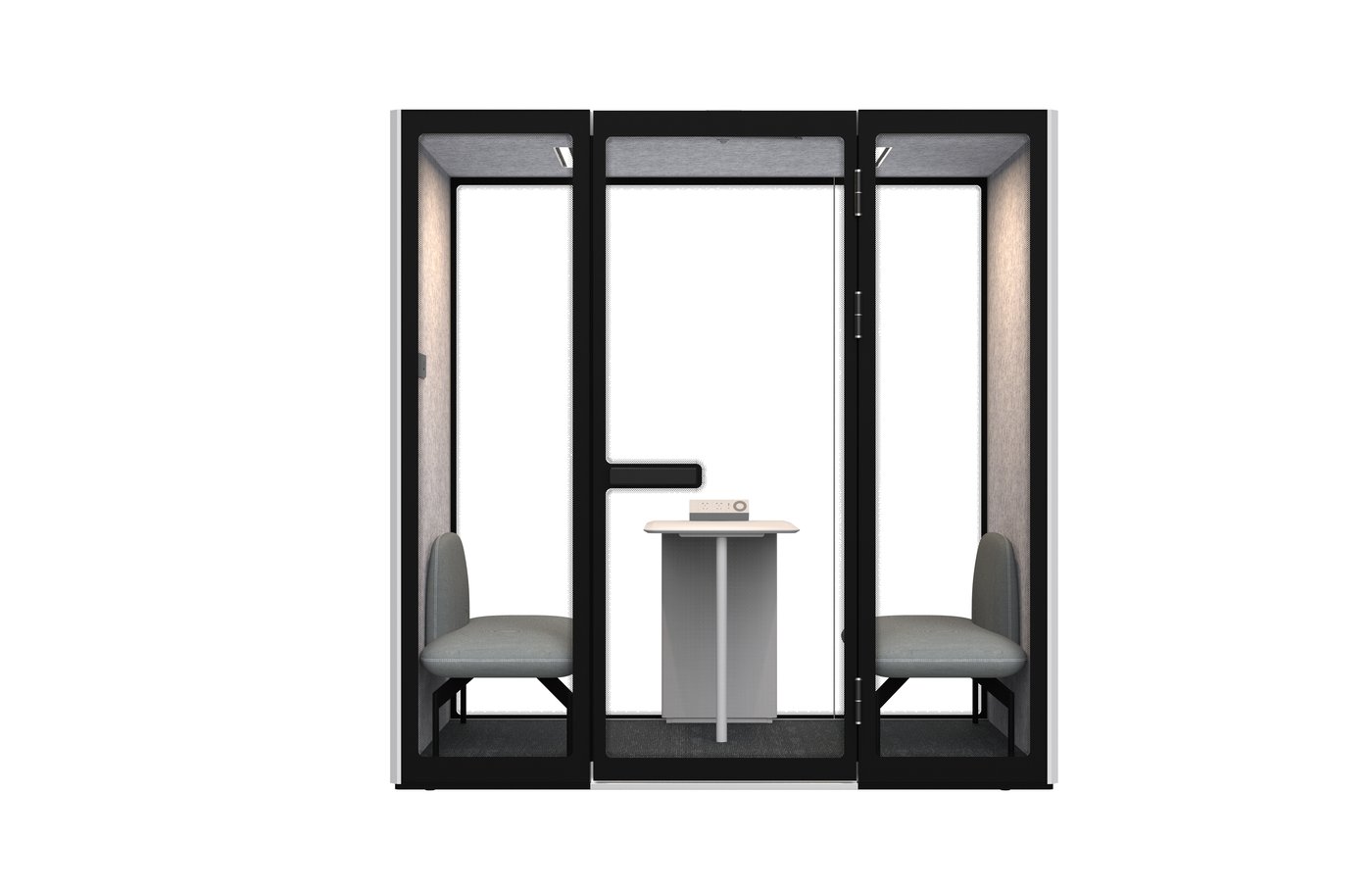
Speech privacy and quiet refuge are the two places a pod helps most. An enclosed pod with a 30±3 dB speech-level reduction measured under ISO 23351-1 is a testable object: the standard exists, the rating is on the assembled unit, and the report can go into the project file. For the quiet-zone side, pods are the practical way to give an open floor a place where a person can make a sensitive call or recover from a loud environment without leaving the office. The detail that matters for the submission is that the rating belongs to the whole pod — door, glass, ventilation running — not to a wall panel inside it. A supplier who has tested properly will give you the report with the configuration named.
Where PET panels earn theirs
Reverberation is the panels' contribution, and the mechanism is simple: enough tested absorption on the ceiling and walls brings the room's reverberation time down into the range the space needs. Ask for the NRC or ISO 354 report on the exact board — the LUME and TDD families sit at NRC 0.80–0.85 — and make sure the coverage calculation matches the room, because a single decorative panel will not move the measurement. The second contribution is quieter but just as useful: PET boards that carry GREENGUARD and OEKO-TEX 100 also support the Air and Materials sides of the project, and the SCS 60% recycled certification plus an EPD gives the sustainability documentation something solid to stand on.
LEED takes a slightly different route
LEED's acoustic credits live in the design and performance of the space rather than in a product list, and its materials credits are where the documents pay off again. Low-emitting materials points lean on emissions evidence such as GREENGUARD; the EPD is a recognised contribution in the materials section; recycled content has its own line. The practical lesson is that one well-documented product can serve several sections of two different standards, but only if the documents arrive with the quotation instead of being chased after installation.
A caution that applies to both standards: no product gives you points on its own. Credits are awarded to spaces and to documentation, not to catalogues. What a good supplier can do is make the space easy to document — tested ratings, named configurations, certificates that match the boards on the quotation. Bring your assessor into the conversation early, ideally before you order, and ask which measurements they will take on the finished floor. Then buy the products that make those measurements easy to pass. That sequence — assessor first, products second — is the difference between a calm submission and an expensive retrofit.
The paperwork habit that saves the submission
Three habits, all cheap. Ask for test reports at quotation stage and check that the report names the product you are actually buying — family, model, configuration. File the reports with the project rather than in a personal inbox, because the assessor, the client and the next tenant will all ask again. And keep a one-page map: which document answers which credit. It takes an afternoon and it turns the acoustics section from a scramble into a checklist. The products are at products/pods, products/decor and products/lighting, and the document pack can be requested with any of them.
BG Acoustics supplies the pod and PET families as a responsible partner backed by BG Office Furniture — Foshan, since 2015, audited production lines, more than 50 export countries, OEM/ODM from 10 sets. Tell us which standard you are submitting against and we will attach the relevant reports to the quotation: emmy@fsbige.com or WhatsApp +86 189 2856 2556. And if you are near Foshan, the showroom at B36-1 Jianshe Road, Lecong, Shunde keeps the reports beside the products — bring the standard, and we will walk through the Sound section together.