
Open Office Noise, Productivity and the 23-Minute Tax: The Business Case for Acoustics
Every open office has an unofficial uniform now: noise-cancelling headphones. Not for music — for survival. When a workplace has to invent a dress code to keep people thinking, something has gone wrong with the workplace itself, not the people. The open office noise problem is usually discussed as a comfort issue, which is why it never gets a budget. It is a productivity issue, and the numbers around it are less comfortable than the debate.
The 23-minute tax
The most useful figure in this conversation comes from interruption research at the University of California, Irvine: after an interruption, it takes an average of 23 minutes and 15 seconds to get fully back to the task you were doing. Not to glance at it again — to be properly back inside the work. A voice behind you, a phone that should have been silenced, a question that could have waited. Each one is cheap on its own and expensive in series. An open floor is an interruption generator by design, because speech is the one sound the human brain refuses to filter out.
Noise is not one problem but three
Start with speech. Steady mechanical hum — fans, printers, the lift — the brain can learn to ignore. Intermittent, intelligible speech is different: your attention system insists on decoding it whether you like it or not. That is why the colleague's phone call is so much more destructive than the air conditioning. Then there is movement, which costs focus before a single decibel registers. And finally the subtler one: people start censoring themselves. Sensitive calls get postponed, difficult conversations move to stairwells, and some staff simply stop raising ideas in the open because the open is too public. You do not see that cost in any acoustic report, but you see it in the meeting that never happened.
Where the cost actually lands
Do the arithmetic on a single floor, as an illustration rather than a promise. Suppose each person loses just two avoidable interruptions a day to chatter and movement, and each recovery costs the better part of the 23-minute figure. Call it 45 minutes of degraded work per person per day. On a 100-person floor that is 75 person-hours daily — the output of nearly ten full-time employees, evaporating into the ceiling. Even if you discount that scenario by half, you are still funding a small team whose entire job is waiting to concentrate. That is the business case for acoustics in one paragraph: you are not buying panels and pods, you are buying back attention you already pay for.
Two objections come up every time, and both are worth answering plainly. "People get used to it." They do not — you can get used to a fan, not to a sentence; habituation fails precisely where the sound carries meaning. "We gave everyone good headphones." That treats the employee, not the office: the calls still happen in the open, the people who need quiet rooms for their work still do not have them, and your newest hire has just learned that concentration is something you do at home.
What the fix looks like in practice
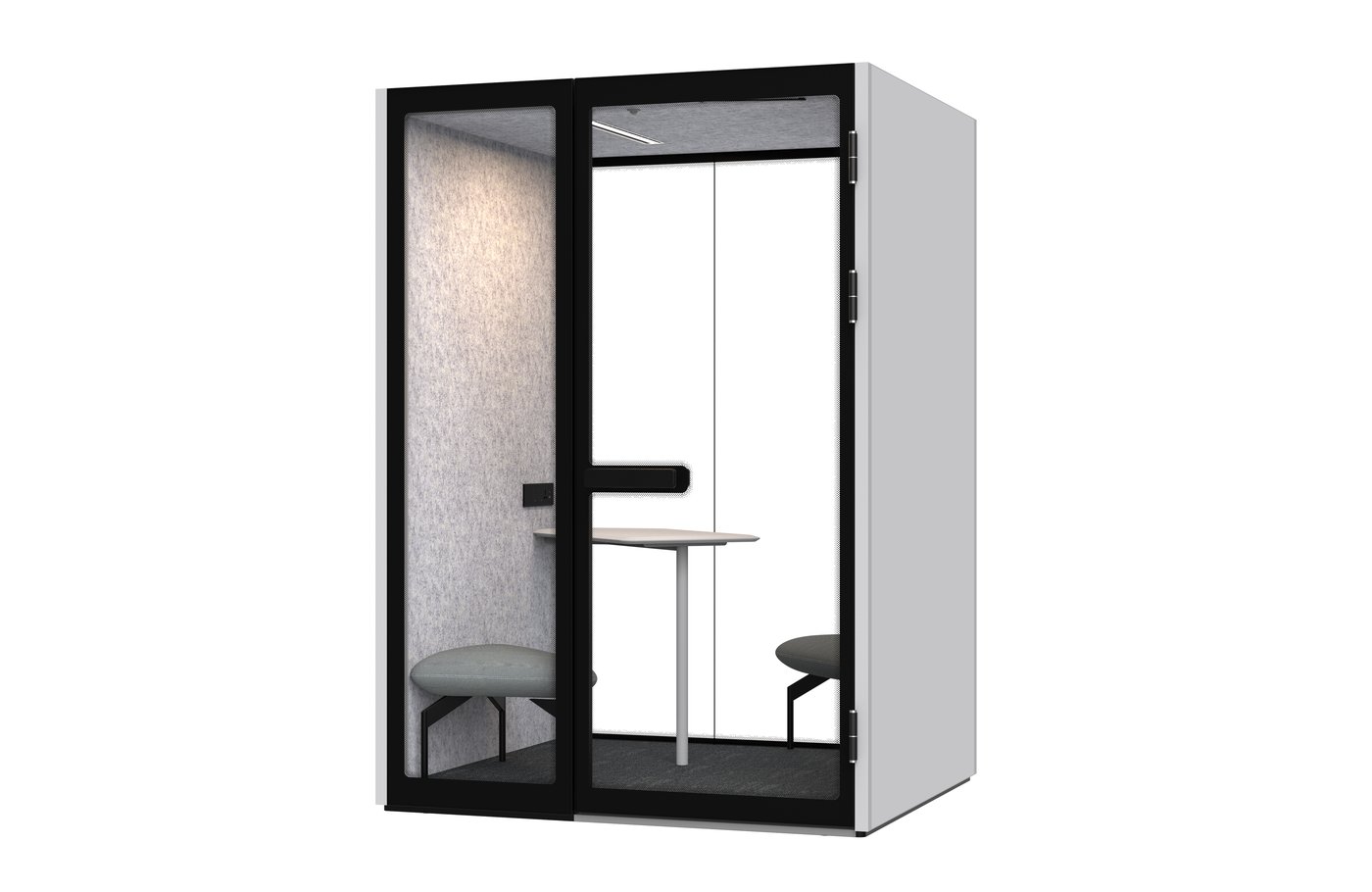
Three layers, because no single product carries a whole floor. Absorb: PET wall and ceiling panels take the energy out of the room before it becomes everyone's problem — the TDB/TVC/TPH/TDD families at products/decor carry NRC-tested absorption and the certificate set for emissions and recycled content. Divide: screens and carved dividers stop sightlines and desk-level chatter at source. Enclose: calls, video meetings and confidential conversations move behind a tested door — the pod range at products/pods carries 30±3 dB speech-level reduction measured under ISO 23351-1, with ventilation sized so people actually stay inside. The goal is not silence; it is making the interruptions optional.
The cheapest test you can run this week
Pick your noisiest day, walk the floor at 10:30 and 15:00, and count. Not decibels — count how many people are wearing headphones, how many conversations are happening in corridors and stairwells, how many desks sit empty because someone went looking for a quiet corner. Those three counts are your baseline, and they cost nothing. If you treat them as seriously as the rent line, the acoustic plan writes itself. And if you want a second opinion on what that plan should contain, send us the floor plan and the three counts — we will answer with a layout, not a lecture.
BG Acoustics supplies the panels, screens and pods as a responsible partner backed by BG Office Furniture — Foshan, since 2015, audited production lines, more than 50 export countries, OEM/ODM from 10 sets. emmy@fsbige.com or WhatsApp +86 189 2856 2556. The showroom at B36-1 Jianshe Road, Lecong, Shunde is a working example of the three layers — worth a visit if you are near Foshan.