
Hybrid Office Design: Phone Booths, Focus Rooms, and the Ten-Step Rule
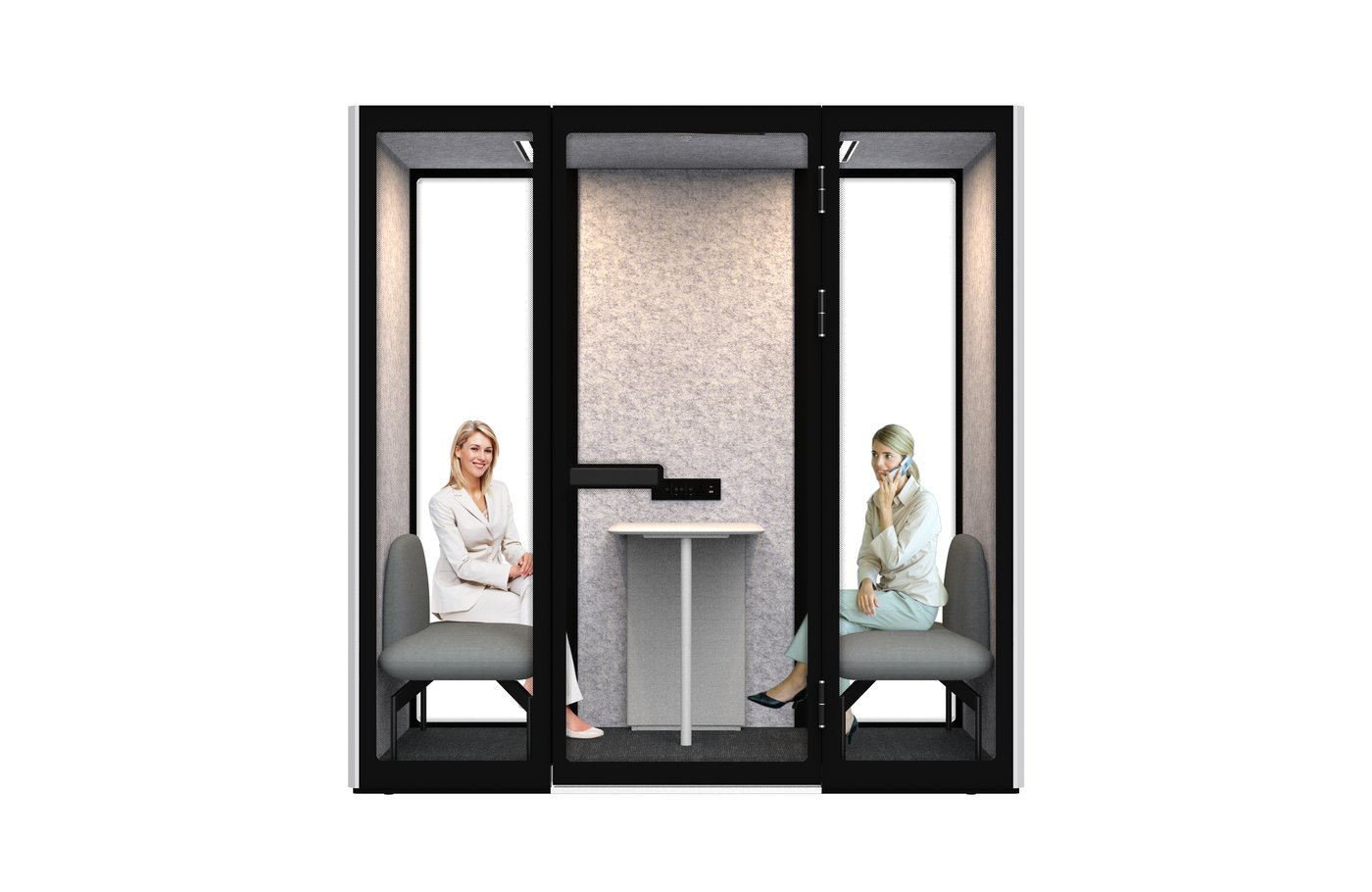
The hybrid office was supposed to be the quiet one. Fewer people, fewer conversations, less noise. Then the Tuesday crowd arrived and everyone spent the day on video calls with the colleagues who stayed home. The open floor did not get quieter; it got more conversational. Hybrid office design in 2026 has one new central problem: every desk is now a potential broadcast studio, and the floor needs somewhere for that voice to go. The answer is a quiet escape within ten steps of every desk — and a clear idea of which kind of escape.
What hybrid actually changed about noise
Two things, and they pull in opposite directions. Attendance is uneven: the floor is full on the collaboration days and thin on the focus days, so the average noise level means nothing — you have to design for Tuesday. At the same time, the calls never went away. A one-to-one that used to happen in a corridor now happens on video, on speaker, at a desk. More calls per person, concentrated into fewer days. That is why the post-hybrid office feels louder than the full-time one ever did, even with fewer people in it.
The ten-step rule
A quiet room only works if it is closer than the alternative. If the nearest booth is a walk to the other end of the floor, people will take the call at their desk — the walk is longer than the embarrassment of disturbing colleagues. Ten steps is a rough planning rule, not a standard: close enough that using the booth is easier than not using it. It also beats the meeting-room booking system. Nobody books a two-person room for a fifteen-minute call; they book it because there is nothing smaller, and then the room is blocked for an hour. The booth removes the booking from the call.
Booths and focus rooms are two different escapes
Do not buy one product and expect it to do both jobs. The phone call escape is the booth-s: 0.96 m², 28±3 dB, 24 W, two fans moving 70 m³/h so the air stays fresh through a long call. The deep-work escape is the work pod — booth-m1-a, a solo cabin with a real desk, 30±3 dB, 140 m³/h of ventilation, somewhere to spend an hour without hearing the floor. And the small-meeting escape is the two-to-six-person pod, from the SL series up to the L and XL meeting pods, with 280 to 560 m³/h behind the same rating. Each is a different answer, and the floor needs the mix, not a favourite.
How many booths does a hybrid floor need?
Start with your own calendar data rather than a universal ratio. Count the simultaneous video calls at the busiest hour of your busiest day — that is the number the floor has to absorb. A common working heuristic is one phone booth for every eight to twelve desks on a call-heavy team, but a sales floor and an engineering floor are different animals. Buy for the measured peak, place them within the ten-step rule, and then watch the usage for a month. The pods are modular and movable, so a second batch is a layout decision, not a construction project.
Two habits keep the numbers honest. Review the access or booking logs once a month and count the hours each booth is occupied — a pod with a smart lock or access system already produces that data for free. And keep the furniture as movable as the headcount: pods on optional silent casters can be rolled toward whichever team is growing, which is the entire point of buying enclosures that are furniture rather than walls. A hybrid floor is never finished; it is rebalanced. The booths just make the rebalancing a ten-minute job.
Making them actually get used
Placement is most of it. Booths go where the calls happen — near the teams that talk, not in the quiet corner where they look tidy. The rest is small operational details: a motion sensor that switches on light and fans the moment someone steps in, so the booth is always ready; adjustable fan speed for people who want near-silence during a recording; and a simple etiquette — the booth is for calls, not for camping. A pod that is booked all day by one person is a meeting room again, just smaller.
BG Acoustics supplies the booth and pod families as a responsible partner backed by BG Office Furniture — Foshan, since 2015, audited production lines, more than 50 export countries, OEM/ODM from 10 sets. Tell us your headcount and your busiest-hour call count and we will suggest a mix and a layout: emmy@fsbige.com or WhatsApp +86 189 2856 2556. And if you are near Foshan, the showroom at B36-1 Jianshe Road, Lecong, Shunde has the whole range standing — take a call from inside one and see how the floor sounds from there.