
Acoustic Workstation Screens for Open Plan Focus: Floor-Level Quiet, Screens vs Pods
Noise in an open office travels at two altitudes. There is the overhead layer — speech energy bouncing off the slab, which baffles and acoustic lighting handle — and there is the ground war: the colleague's voice arriving directly at your ear from the next desk, and the visual motion in your peripheral vision that costs you the thread of thought before any decibel is counted. Acoustic workstation screens for open plan focus fight at desk level, where distraction is actually born. This guide explains what a screen workstation really fixes, when you need a pod instead, and how to scale the answer from one bay to a whole floor.
What does a screen workstation actually fix?
Two things at once, which is why it outperforms a plain desk divider. First, the eyes: visual interruption is the fastest attention killer in an open plan, and a frosted surround — like the double-sided frosted acrylic on the screen-obera — filters motion and faces without killing the light. Second, the ears: a core of acoustic foam or cotton at ear height absorbs chatter at the point of emission, before it joins the ambient soup. The Obera wraps the sitter in a polyurethane foam panel with a wood-veneer tabletop, an extendable multi-angle writing board and a German WALDMANN task lamp — a complete solo focus station, not a fence. Freestanding, W1305 × D904 or D1858 × H1197 mm, six shell colours: furniture, not construction.
Screen workstation or pod — when do you use which?
The honest rule: if the task is the desk, screen it; if the task leaves the desk, pod it. Deep solo work — writing, analysis, design — needs all-day comfort, a real worktop, good light and relief from interruption: that is screen territory, and an Obera or a curved Rhine bay delivers it in the middle of the team, no booking required. A phone call, a video meeting, an interview or anything confidential needs an enclosed shell with a tested rating: that is pod territory — 30±3 dB under ISO 23351-1 from products/pods. The two are not competitors. The floor that works has both: screens where people sit all day, pods within a ten-step walk for everything that speaks.
How do modular screens scale with the team?
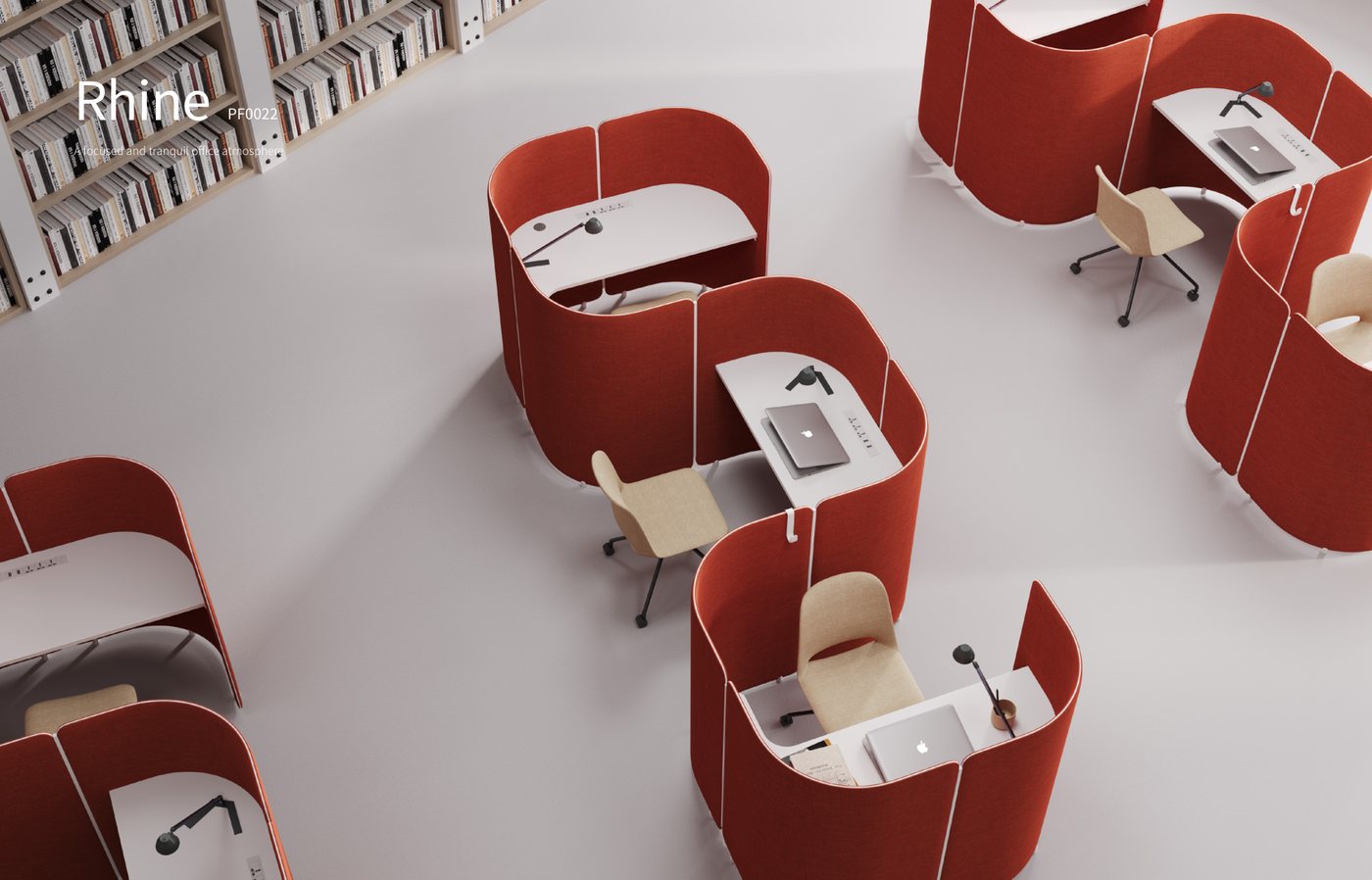
This is where the current generation of screen systems earns its name. The Rhine PF0022 combines flat and curved panels — H1235 or H1435 mm, widths from 646 to 1400 mm — from a single bay of W1435 × D723 mm up to six-person clusters, with matching sofa modules that turn the curve into a lounge. The Roma PF0001·PF0045 builds steel-framed screens with a soft acoustic core around an integrated work table with its own socket — and planter-ready tops for the biophilic brief. The screen-romaplus raises the ladder with panel heights of 1200, 1350 and 1820 mm — seated privacy, standing privacy, near-room — and semi-transparent tops that keep the floor feeling open while the acoustic core keeps it quiet. All freestanding, all modular, all reconfigurable when the org chart changes.
What about the spaces between the desks?
Focus is not the only floor-level problem; so is the pop-up meeting. The ws-dialogue is a mobile whiteboard screen — W1100 or W1600 × H1933 mm — with a Japanese enamel writing surface on one face and an acoustic foam core in between, rolling on silent PU brake wheels one person can move. Park two next to a scrum table and you have a brainstorm corner that absorbs its own noise; roll them apart and the floor is open again. The ws-memo-tree does the same trick as a sculptural divider whose every PET leaf is a magnetic whiteboard. Agile furniture for agile teams — and none of it touches the building.
How do you plan floor-level quiet across a whole floor?
Five moves. One: map the talkers — sales pods, scrum corners, the pantry — and put ear-height absorption closest to them. Two: choose screen heights by posture: around 1200–1235 mm for seated privacy, 1435–1820 mm where standing conversations need blocking. Three: specify real materials — E1-grade boards, eco XPE and PU foam cores, melamine-faced tops — and ask for the documentation. Four: use colour deliberately; the DOV six-colour shell card lets teams own their bays. Five: leave speech to the pods — a screen is not a booth, and pretending otherwise is how floors get noisy reputations. Compare the full range at products/workstations.
BG Acoustics is a responsible supplier backed by BG Office Furniture, established in Foshan in 2015, working with audited production lines and shipping to more than 50 countries, with OEM/ODM service from a minimum order of 10 sets. For a quotation with layout suggestions and material documentation attached, message us on WhatsApp at +86 189 2856 2556 or email emmy@fsbige.com. And if you are near Foshan, visit the showroom at B36-1 Jianshe Road, Lecong, Shunde — sit in an Obera for ten minutes and read something.