
Acoustic Ceiling Baffles vs Ceiling Tiles: How to Choose for an Exposed Soffit
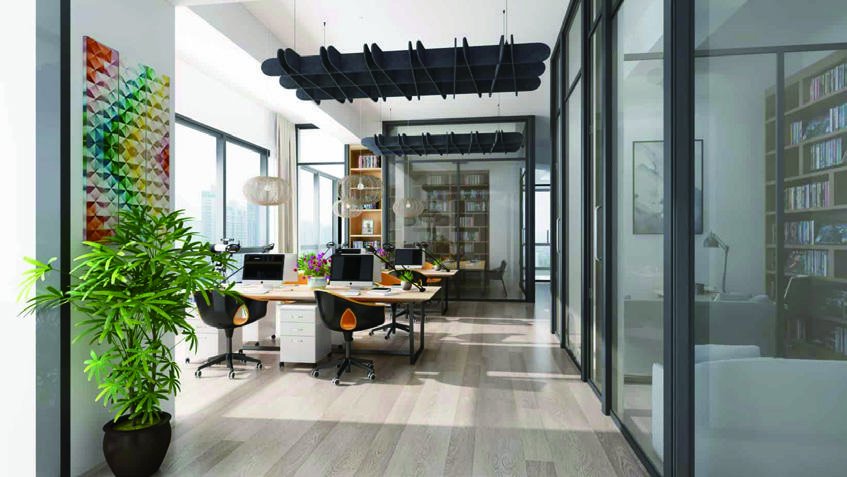
The ceiling decision usually happens in five minutes, in a meeting about something else. Someone says "we'll just put a grid in" and the open-plenum design dies there. Or someone says "leave it exposed, it's beautiful" and six months later the office is gorgeous and unusable. Acoustic ceiling baffles vs ceiling tiles is not an aesthetic argument; it is a decision about how your room will sound, how your services will be maintained, and how tall your space will feel. Both can be right. The mistake is choosing by photograph.
What a tile ceiling does quietly well
A suspended tile ceiling is the acoustic default for a reason. It gives you a continuous plane of porous material over the whole room, which is the single most effective way to stop speech energy bouncing around above people's heads. It hides the ductwork, gives you a plenum for cabling and air handling, and arrives as a known system that every contractor can price and install without a learning curve. In an enclosed meeting room with a standard ceiling height, it is usually the sensible answer. The trade-offs are the ones everyone knows but forgets to say out loud: the grid reads institutional, the room loses visible height, and tiles stain, sag and date. Accessing a valve above a tile means lifting panels and hoping they go back straight.
What baffles do that tiles can't
Baffles hang vertically, and that geometry changes everything. A blade presents two faces to the room, so a metre of baffle absorbs on both sides and catches the sideways-travelling reflections that a flat overhead plane misses. The slab stays visible, the height stays, the ducts and sprinklers stay accessible — a blade comes down in minutes and goes back the same way. The TDD baffle family plays this in waves, slats, grilles and freeform shapes: 9, 12 or 18 mm PET felt, 54 stock colours, quick-fit hardware, and cut-to-fit around whatever the services actually look like on site. Where tiles would bury a beautiful concrete soffit, baffles let it keep working.
And when clouds are the better instrument
Clouds are the horizontal member of the same family: islands of PET felt suspended over a point rather than a plane. They earn their place above the things that make noise in one spot — the collaboration table, the reception desk, the breakout booth that is not quite a booth. The decor-cloud series goes from φ600 to φ1200 mm, in matrix and flower forms, with an integrated LED option, so the cloud can be the light fixture as well as the absorber. If a baffle ceiling is a rhythm, a cloud is a focal point, and some of the best ceilings use both: blades along the desk rows, one cloud over each meeting table.
The honest comparison
On raw absorption per square metre of ceiling, tiles win by default — they are the whole ceiling, and coverage is free once the grid is up. Baffles require you to do the arithmetic: coverage ratio, blade depth, spacing, and a reverberation target. Any supplier who quotes you baffles without asking for the floor plan and the room volume is selling you decoration. On look and height, baffles win easily. On maintenance access, baffles win again. On enclosed rooms with low ceilings, tiles are usually right and baffles are usually wrong — a 2.4 m room with blades hanging into it feels like a car wash. The hybrid answer is common and sensible: tiles in the enclosed rooms, baffles in the open areas, clouds over the tables.
Questions to settle before the ceiling plan is signed
Six of them. What is the clear height under the services, not just under the slab? What does the services map look like — sprinklers, detectors, air terminals — and who has signed off the clearances? What reverberation time are you targeting, and has anyone calculated coverage from the actual room? What does the mounting hardware look like, and can one person remove a blade for maintenance? Are the material certificates in hand — GREENGUARD, OEKO-TEX 100, SCS 60% recycled content, EPD, REACH, RoHS? And finally, has anyone looked at the ceiling in a render at eye height rather than from above? Both systems are at products/decor, and if the ceiling needs light built into the treatment, the lume-baffle and decor-cloud options at products/lighting do that in the same object.
BG Acoustics supplies baffles, clouds and tiles as a responsible partner backed by BG Office Furniture — Foshan, since 2015, audited production lines, more than 50 export countries, OEM/ODM from 10 sets. Send a reflected ceiling plan and we will come back with a coverage calculation and a layout: emmy@fsbige.com or WhatsApp +86 189 2856 2556. And if you are near Foshan, look up in the showroom at B36-1 Jianshe Road, Lecong, Shunde — the exposed soffit there is doing exactly what this article describes.