
Acoustic Baffle Lighting for Exposed Ceilings: Treating the Open Plenum with Blade Lights
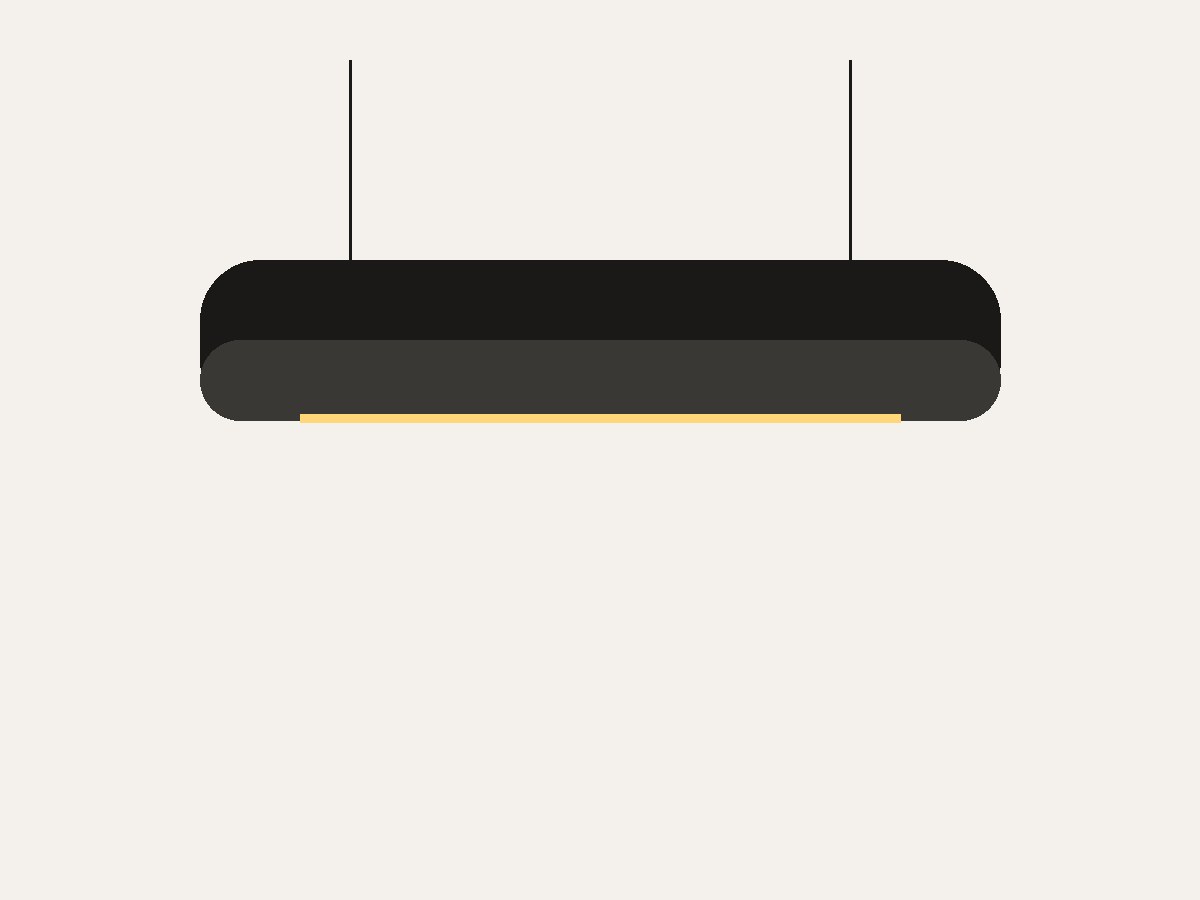
Exposed ceilings won the design argument years ago. Concrete slab, spiral duct, cable tray — the open plenum reads honest, industrial and tall, and tenants love it. The acoustic bill arrives later: with no suspended tile plane to absorb anything, every conversation hits raw concrete and comes back. Acoustic baffle lighting for exposed ceilings is the fix that respects the aesthetic — vertical blades that hang in the plenum, absorb on both faces, and carry the light with them. This guide explains why the open plenum is so hard on speech, and how to treat it without covering it up.
Why do exposed ceilings sound so bad?
A standard suspended ceiling is secretly the biggest absorber in the office: a continuous plane of porous tile sitting in exactly the place where speech energy collects. Remove it and the room loses its acoustic referee. Bare concrete reflects roughly nineteen-twentieths of the sound that strikes it; ducts and pipes add hard curved surfaces that scatter speech further; and the extra ceiling height that makes the space feel generous also gives reverberation more room to bloom. The result is the familiar open-plenum office: beautiful, honest, and tiring by three in the afternoon.
Why do vertical baffles beat horizontal panels up there?
Physics first. A vertical blade presents two faces to the room, so a metre of baffle catches roughly twice the sound of a metre of flat panel — and it intercepts the sideways-travelling reflections that flat overhead panels miss. Logistics second. The plenum is full of ducts, sprinklers, sensors and cable trays that must stay accessible; suspended blades thread between services instead of burying them, and each one comes down in minutes for maintenance. Aesthetics third: baffles keep the slab visible, so the industrial look survives. The decor-ceiling family plays this in waves, slats, grilles and freeform blades — 9, 12 or 18 mm PET felt in 54 stock colours, hung on quick-fit hardware and cut to fit around whatever the services throw at you.
What happens when the baffle also carries the light?
The plenum gets genuinely simple. The lume-baffle is a blade of heat-formed PET acoustic felt, NRC 0.80–0.85, with a specification-grade LED built in: 100 lumens per watt, Ra ≥ 90, selectable 3000 / 4000 / 6500 K, 0–10 V or DALI dimming optional, 220 V with 3C certification. Two lengths — L1400 and L2100 mm, both 700 mm deep — at 14 and 20 kg, so one suspension line does the work of two systems. Where the design calls for a sculptural moment rather than a rhythm of blades, the decor-cloud family hangs round PET clouds of φ600 to 1200 mm with integrated LED — matrix and flower forms that read as art and measure as absorption. Either way, the light and the acoustic treatment share one hanging system, one finish, one trade.
How do you lay baffles out on an open plenum?
Four rules carry most projects. One: run blades perpendicular to the main speech paths — across desk rows, not along them — so the broad faces intercept conversations. Two: keep spacing honest; as a working heuristic, gaps roughly equal to blade depth keep airflow, sprinklers and coverage in balance, but let the supplier's reverberation calculation fix the real number. Three: respect the services map — maintain clear zones around sprinklers, detectors and air terminals, and lift the layout on the reflected ceiling plan before anyone hangs anything. Four: use colour with intent — a single tone calms; alternating tones zone the floor from above. With 54 stock colours and custom cuts, the ceiling can carry the wayfinding too.
What about compliance and indoor air up there?
Everything overhead gets breathed by everyone below, so material certificates matter as much as acoustic ones. The TDD ceiling families carry GREENGUARD, OEKO-TEX 100, SCS 60 % recycled content, EPD, REACH and RoHS documentation — the set that lets a baffle into a WELL or LEED project without a fight. The electrical side is separate and just as documented: the luminaire runs 220 V with 3C certification. Ask for both dossiers in the same quotation; a supplier who has engineered the product sends them without being chased.
What should you confirm before specifying?
Six checks. One: the NRC report — a tested range like 0.80–0.85. Two: blade dimensions and thickness — 9, 12 or 18 mm changes both look and absorption. Three: the mounting system — quick-fit hardware and cut-to-fit make the difference between a two-day and a two-week ceiling. Four: the layout calculation — reverberation targets sized from your floor plan, not a guess. Five: the certificates — GREENGUARD, OEKO-TEX, recycled content, EPD, REACH, RoHS. Six: the light — 100 lm/W, Ra ≥ 90, the right CCT, the right dimming protocol. Browse the blade luminaires at products/lighting and the pure ceiling systems at products/decor, then send the plan.
BG Acoustics is a responsible supplier backed by BG Office Furniture, established in Foshan in 2015, working with audited production lines and shipping to more than 50 countries, with OEM/ODM service from a minimum order of 10 sets. For a quotation with the acoustic calculation and certificate dossier attached, message us on WhatsApp at +86 189 2856 2556 or email emmy@fsbige.com. And if you are near Foshan, visit the showroom at B36-1 Jianshe Road, Lecong, Shunde — the open plenum there is deliberately loud until you walk under the blades.