
3D Acoustic Wall Tiles for Office Design: Moulded PET Tiles for Feature Walls That Work
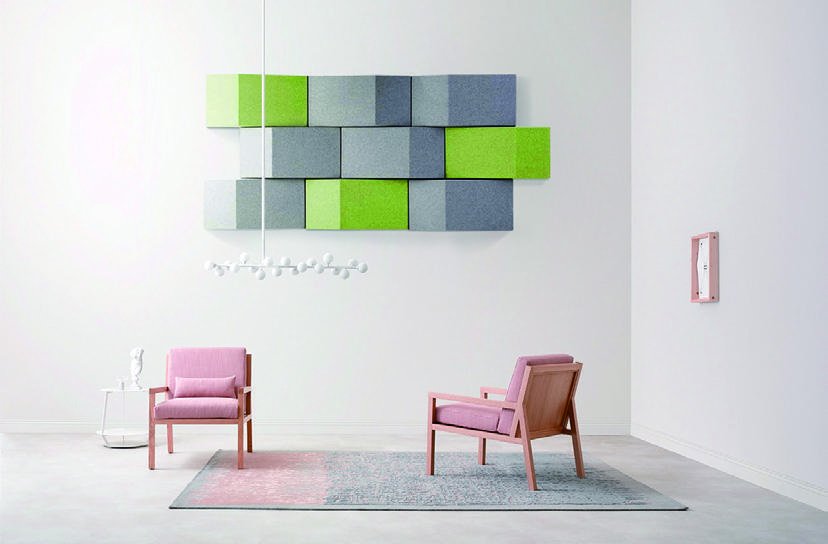
A feature wall in an office usually means paint, wallpaper or a printed panel. It looks fine on a photo and does nothing for the room. 3D acoustic wall tiles are the alternative where the visual job and the acoustic job are done by the same object: moulded PET geometry that catches light and shadow all day, and a dense felt body that absorbs sound while it looks good. This is the guide to the two families — T3D and Wave — and where each earns its place on an office floor.
Why a 3D wall works harder than paint
Relief changes everything a wall does. A flat surface reflects light evenly and sound evenly; a moulded one breaks both. Raking light across flutes and arcs gives the wall a texture that shifts with the day — morning light draws long shadows, afternoon light shortens them — so the wall looks designed without any maintenance. The same relief works on sound differently from flat absorption: the peaks and valleys scatter some of the reflected energy while the PET body absorbs the rest. The result is a wall that reads as intentional architecture and performs as acoustic treatment, in one product.
Two families, two geometries
The T3D family is heat-moulded into flutes, facets and arcs — T3D-01 through T3D-07, in 400 × 400 and 500 × 500 mm modules, plus large-format 2400 × 1200 × 10.5 mm boards for faster coverage. The quarter-arc modules rotate into endless patterns, so the same box of tiles can produce a dozen different walls depending on how you lay them. The surface is a matte PET texture that reads premium in person — the kind of finish that makes people reach out and touch it.
The Wave family takes a different approach: one mould, many walls. The 550 × 550 mm quarter-circle arc module rotates in layout, so four tiles redraw the pattern daily if you want them to. The surface is smooth PET, with an optional fabric or wool-felt pressing for projects that want a softer face. Where T3D is sculptural relief, Wave is rhythmic pattern — two complementary answers to the same question.
Where 3D tiles earn their place
Reception first, because it is the wall everyone photographs and the wall everyone hears. Then the boardroom backdrop: the wall behind the meeting table is both the visual anchor and the echo source, and 3D tiles fix both at once. Corridors benefit from the rhythm — a long run of Wave modules turns a bare passage into a designed route. And video-call backgrounds: a relief wall behind a desk gives your calls texture without distraction, which is why more of these tiles end up behind executive cameras than behind reception desks.
Mounting and colour
The practical part is refreshingly simple. Tiles mount with glue or nails in minutes — no frame, no second trade, no closure of the space. Because the material is through-coloured, a trimmed edge stays clean, and the 54-colour stock card covers both families plus the rest of the PET range, so the wall, the pendants and the screens can all be specified in the same tone. For the paperwork side, the families carry GREENGUARD for indoor air, OEKO-TEX 100 for substances, SCS 60% recycled content, EPD, REACH and RoHS — the set that lets a feature wall into a WELL or LEED project without a fight.
What to check before ordering
Ask for the absorption data on the exact tile, because 3D geometry changes what the surface does — you want the report, not the adjective. Ask for a sample tile or two and hold them against the light: texture reads differently in person than in a render, and it is the main reason to buy these over flat panels. Check the colour card against your ambient light, and plan the layout pattern before the tiles arrive — the quarter-arc logic rewards a little forethought.
On quantities, a simple arithmetic before you order. Count the wall's square metres, divide by the tile size, and add five to ten percent for cuts and layout adjustments. The supplier can check the number against your plan and tell you whether the large-format boards or the small modules make more sense for your wall — sometimes a mix of both is the right answer, with boards for the big field and modules for the feature zone. Everything is at products/decor, and if the project also needs quiet rooms rather than quiet walls, products/pods completes the brief.
BG Acoustics supplies the T3D and Wave families as a responsible partner backed by BG Office Furniture — Foshan, since 2015, audited production lines, more than 50 export countries, OEM/ODM from 10 sets. Tell us the wall's dimensions and the look you are after and we will suggest a family, a colour and a layout: emmy@fsbige.com or WhatsApp +86 189 2856 2556. And if you are near Foshan, the showroom at B36-1 Jianshe Road, Lecong, Shunde has these tiles on the wall — run your hand across the relief and you will understand why people choose them over paint.