
Office Phone Booth Ventilation and Air Quality: Why Air Changes Decide Whether a Pod Gets Used
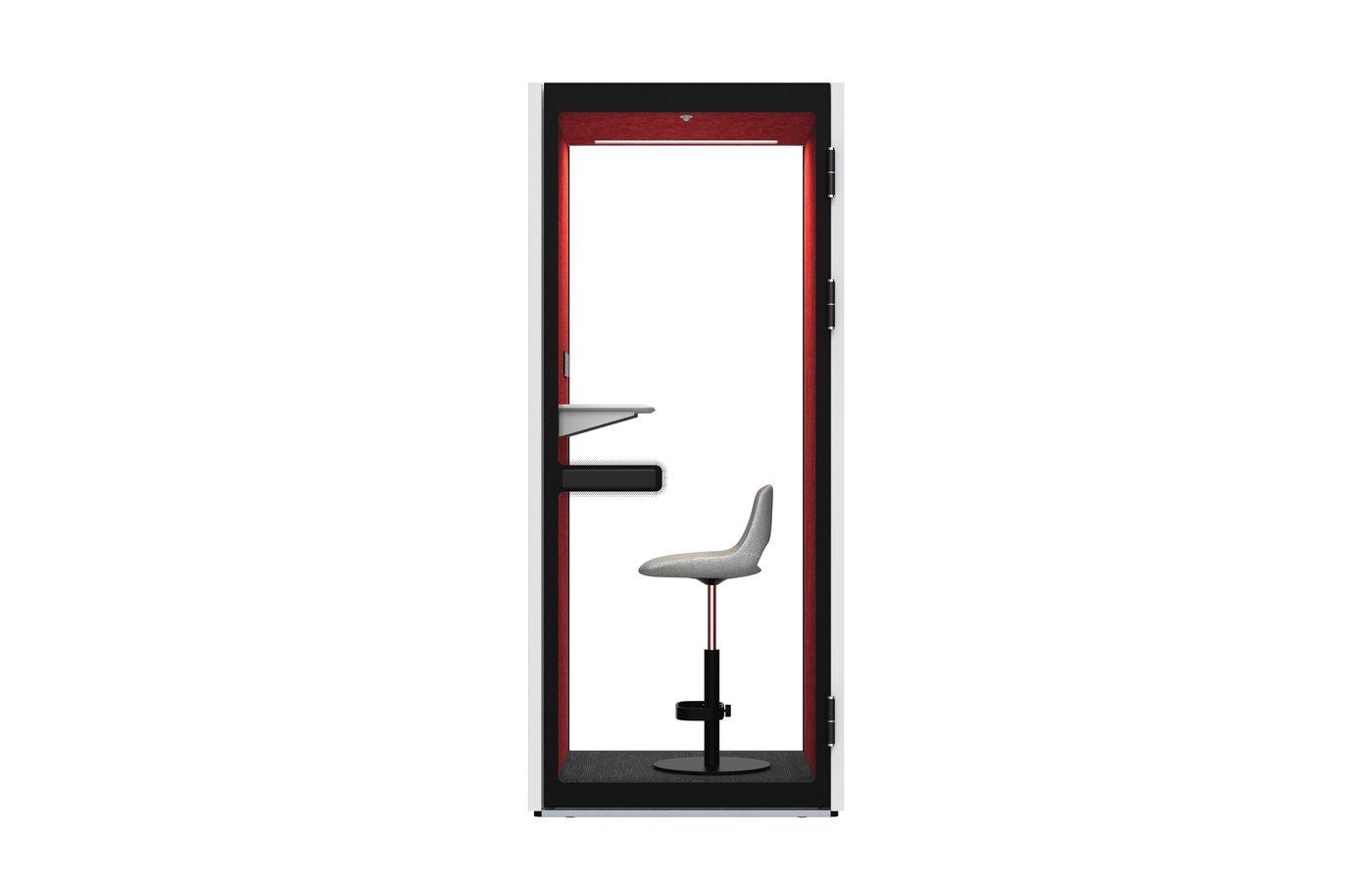
You did everything right. The open floor was too loud, so you bought phone booths — proper ones, with a real ISO 23351-1 rating. Six months later, the usage report is embarrassing: the booths stand empty most of the day. Ask the team why, and the answer is not acoustic. After ten minutes inside, the air goes warm and stale, the glass mists over, and people step out mid-call to breathe. The sound stays out; so does the oxygen. In a box engineered to keep 60 dB of speech from escaping, ventilation is not a comfort feature — it is the feature that decides whether the pod gets used at all. This guide explains the numbers behind office phone booth ventilation and air quality, and how to read them in a quotation.
Why does a sealed booth turn stuffy so quickly?
A one-person phone pod has an interior of roughly 1.6 cubic metres — about the volume of two bathtubs. A seated adult on a video call is a steady source of heat, humidity and CO₂. In a small sealed enclosure with no active airflow, CO₂ concentrations climb past accepted comfort levels within minutes; humidity from breath condenses on the cooler glass; the air develops the flat, used smell every facilities manager knows from old meeting rooms.
Here is the paradox: the better the acoustic seal, the worse the air. A pod that genuinely stops speech from leaking out also stops air from leaking out. Door seals, laminated glass and gasketed cable ports — the very components that earn a 30 dB rating — turn the cabin into a closed jar. Passive vents cannot fix this without compromising the acoustics. The only honest solution is powered airflow, engineered and sized to the cabin.
What does "air changes per hour" actually tell you?
Air changes per hour (ACH) is the simplest ventilation metric: how many times the full interior volume is replaced in one hour. Divide the fan capacity by the internal volume and you have it. Take the Comine Booth 2026 series as a worked example. The booth-s phone pod moves 70 m³ of air per hour through two fans; its interior is about 1.6 m³, so it achieves roughly 43 air changes per hour — the entire atmosphere of the cabin is replaced about every 80 seconds. The booth-m1-a work pod pushes 140 m³/h through four fans over a 3.4 m³ interior: around 41 ACH. Scale up and the ratio holds: the four-person booth-l1-a runs eight fans at 280 m³/h (≈ 58 ACH), and the six-person booth-xl-a runs sixteen fans at 560 m³/h (≈ 71 ACH).
For context, a typical air-conditioned office manages four to ten air changes per hour. A well-designed pod should exceed that several times over, because its volume is small and its occupancy density is extreme — one person per square metre or more. When a quotation states fan capacity but not interior volume, ask for both and do this division yourself. It takes ten seconds and reveals more than any "turbo ventilation" adjective.
Where does the air actually go?
Airflow quality matters as much as quantity. The Comine series uses top-in top-out silent ventilation: fresh air is drawn in at roof level, flows down around the occupant and exits upward, so no draft ever blows directly at face or neck — the detail that makes a 45-minute call comfortable rather than merely survivable. Fan speed is adjustable from the touch panel, so users can trade a little airflow for near-total silence during a recording, or run maximum flow after the previous occupant leaves.
The air path is also an acoustic decision. Every opening in the shell is a potential sound leak, which is why ventilation ducts in a serious pod are baffled and routed to absorb sound rather than transmit it. This is where a quotation reveals whether the supplier has genuinely engineered the product or simply drilled holes and hoped.
Why do the fans decide the acoustic rating too?
A pod's ISO 23351-1 test is run on the fully assembled unit — door, seals, glass and ventilation installed. Ask whether the measurement was taken with the fans running. It should be: that is the configuration your staff will actually use. A pod that forces users to choose between fresh air and silence has failed twice, because people will choose air every time and the acoustic investment evaporates.
Fan noise itself should sit below the office background — another reason the fans matter more than the decibel sheet suggests. And the energy side is just as practical: the whole booth-s, fans and light included, draws 24 W, less than a laptop charger. A motion sensor switches light and fans on when someone enters and off when they leave, so booths ventilate only when occupied and standby consumption stays near zero. Every model runs on 110–220 V, so the same pod ships to Riyadh, Paris or São Paulo without modification.
How should you judge office phone booth ventilation and air quality before buying?
Five questions separate engineered airflow from marketing. One: does the quotation state fan capacity per model in m³/h? Two: can the supplier give the interior volume, so you can compute ACH yourself? Three: was the acoustic test run with ventilation operating? Four: is fan speed adjustable and is the air path baffled against sound leak? Five: does a motion sensor automate the whole system, or does usage depend on people remembering a switch?
When the answers are documented, the pod will be used. When they are missing, the pod becomes expensive luggage. Browse the full range at products/pods to compare sizes, capacities and airflow side by side.
BG Acoustics is a responsible supplier backed by BG Office Furniture (established 2015), working with audited production lines in Foshan and shipping to more than 50 countries, with OEM/ODM service from a minimum order of 10 sets. For a quotation with airflow and acoustic documentation attached, message us on WhatsApp at +86 189 2856 2556 or email emmy@fsbige.com — or visit the showroom at B36-1 Jianshe Road, Lecong, Shunde, Foshan and stand inside a booth-s for ten minutes. The air will still be fresh.