
Accessible Office Pod, Wheelchair and ADA: What Barrier-Free Really Means on a Spec Sheet
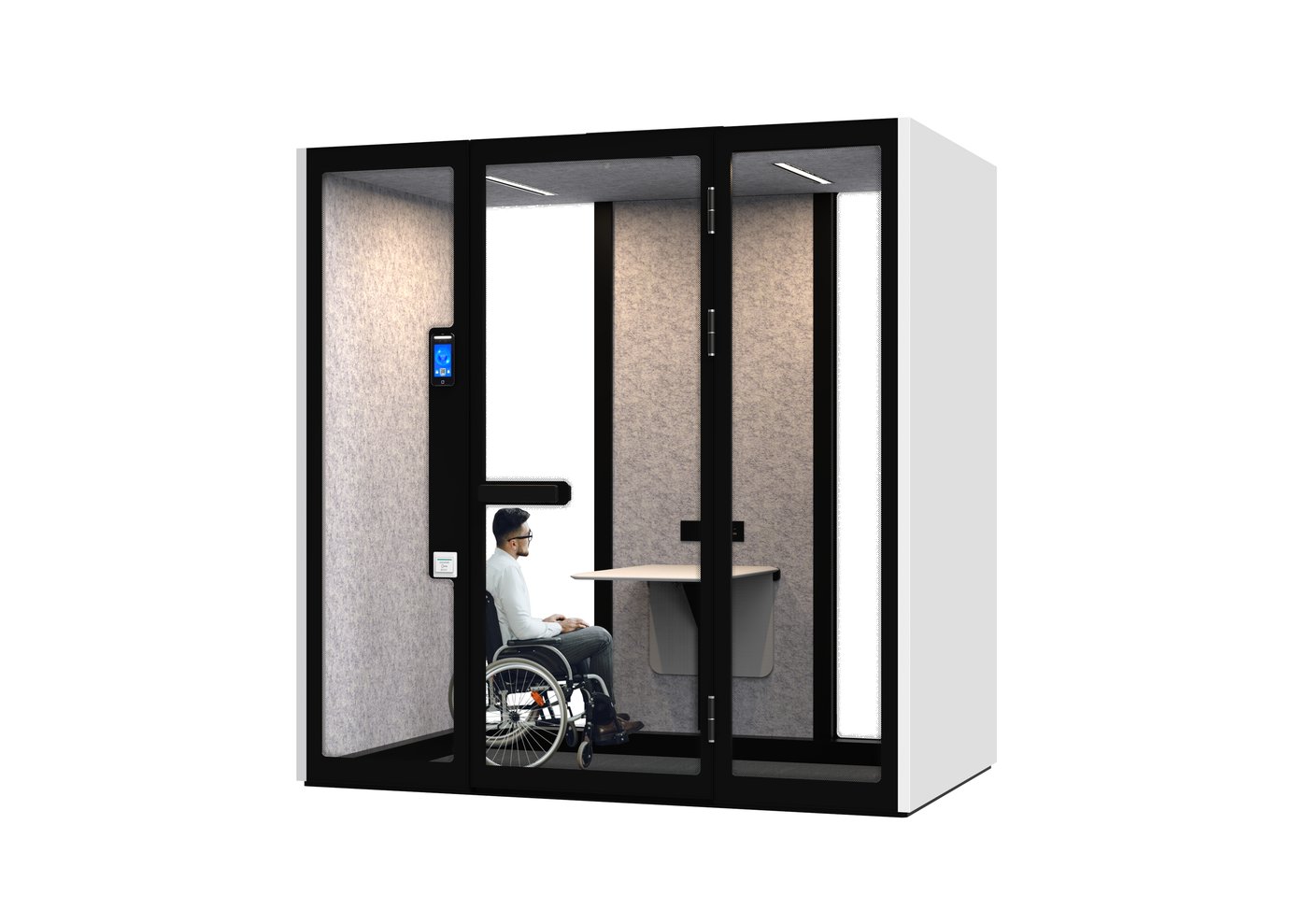
An office can be proud of its quiet rooms and still exclude the people who need them most. Most acoustic pods on the market present a raised threshold, a narrow swing door and a manual handle — three small details that add up to a locked door for a wheelchair user, a colleague on crutches, or anyone carrying a laptop bag and a coffee at the same time. As accessibility moves from a nice-to-have to a procurement requirement — ADA in the United States, EN 17210 in Europe and similar codes elsewhere — buyers increasingly search for one phrase: accessible office pod, wheelchair-ready, ADA-aware. This guide explains what that phrase should actually mean on a specification sheet.
What does "accessible" actually require in an office pod?
Accessibility standards converge on a handful of measurable demands. The doorway needs a clear opening wide enough for a wheelchair — the ADA benchmark is 32 inches (about 815 mm) — with a threshold that is flush or bevelled, never a step. Inside, the user needs room to turn: the classic figure is a 60-inch (1525 mm) turning circle, or a T-shaped turning space. Controls — light, ventilation, sockets — must sit within reach of a seated person, and the door must not demand a strong pull: closing force and handle height are regulated for a reason. Finally, entry must be possible without assistance, because independence is the entire point. When a supplier says "accessible", these are the numbers to ask for — in writing, with drawings.
How does the doorway decide everything?
The door is where most pods fail. A barrier-free pod starts with a wide, level entry: no raised track, no step, nothing to catch a front castor. The Accessible Pod series takes this further with an automatic electric door closer and magnetic lock — the door opens and closes without the user pulling or pushing against spring force, which is exactly what the ADA's opening-force limits are designed to protect. On the two-person accessible-l2-a, the desktop folds away to clear the entry path, so a wheelchair user can roll straight in and position themselves without negotiating around furniture. Ask any pod supplier two questions: what is the clear opening width, and what force does the door demand? The answers sort real accessibility from marketing.
Why does touchless access matter as much as door width?
A door you cannot unlock is a wall. Traditional pods assume a hand that can grip, turn and pull. The Accessible Pod series offers five ways in: facial recognition, QR code, card, password or manual — so a user with limited dexterity, or simply full hands, enters on their own terms. Facial recognition is the quiet breakthrough here: no card to fish from a wallet, no handle to grip, no code to type with cold fingers. Inside, the motion sensor continues the same philosophy — light and ventilation switch on when someone enters and off when they leave, so there is no switch to find, reach or remember. Accessibility is not one feature; it is the removal of every small negotiation.
What should you check inside the cabin?
Space first. The solo accessible-m2-a offers an interior of W1408 × D1202 mm over a 2.1 m² footprint; the duo accessible-l2-a stretches to W2003 × D1202 mm. Compare these dimensions with the 1525 mm turning circle and request the supplier's layout drawing showing wheelchair position, desk and door swing — an honest supplier has this drawing ready. The desk matters too: the M2-A offers an optional height-adjustable desk, so the work surface meets the chair rather than the reverse. Then the comfort systems: four fans moving 140 m³/h in the M2-A (eight fans, 280 m³/h in the L2-A) keep the air fresh, the 5000 K LED is dimmable and flicker-free, and both pods hold a 30±3 dB speech-level reduction measured under ISO 23351-1 — the same acoustic performance as the standard range, because accessibility should never mean a downgrade. Both run on 110–220 V, so the same specification ships to any region.
One pod or an inclusive workplace policy?
A single accessible pod is a gesture; a plan is a policy. Workplace teams increasingly apply the same logic as parking: accessible units placed first, near step-free routes and lifts, distributed so that no floor or department is without one. The payoff is wider than compliance. Barrier-free entries serve the colleague on crutches after a football injury, the parent wheeling a pram into a parents' room, the courier with a trolley — and they signal to every candidate that inclusion here is built, not promised. You can compare capacities and layouts across the full range at products/pods.
What should you ask before you order?
Six questions. One: what is the clear door opening, in millimetres? Two: is the threshold flush, and what is its profile? Three: can the supplier provide a turning-space drawing of the interior? Four: at what height are the controls and sockets? Five: does the door close automatically, and with what force? Six: in how many ways can a user get in — and does any of them require grip or reach? A supplier who answers all six with numbers has engineered accessibility. One who answers with adjectives has not.
BG Acoustics is a responsible supplier backed by BG Office Furniture, established in Foshan in 2015, working with audited production lines and shipping to more than 50 countries, with OEM/ODM service from a minimum order of 10 sets. For a quotation with dimension drawings and access-system documentation attached, message us on WhatsApp at +86 189 2856 2556 or email emmy@fsbige.com. And if you are near Foshan, visit the showroom at B36-1 Jianshe Road, Lecong, Shunde — and test the doorway yourself.